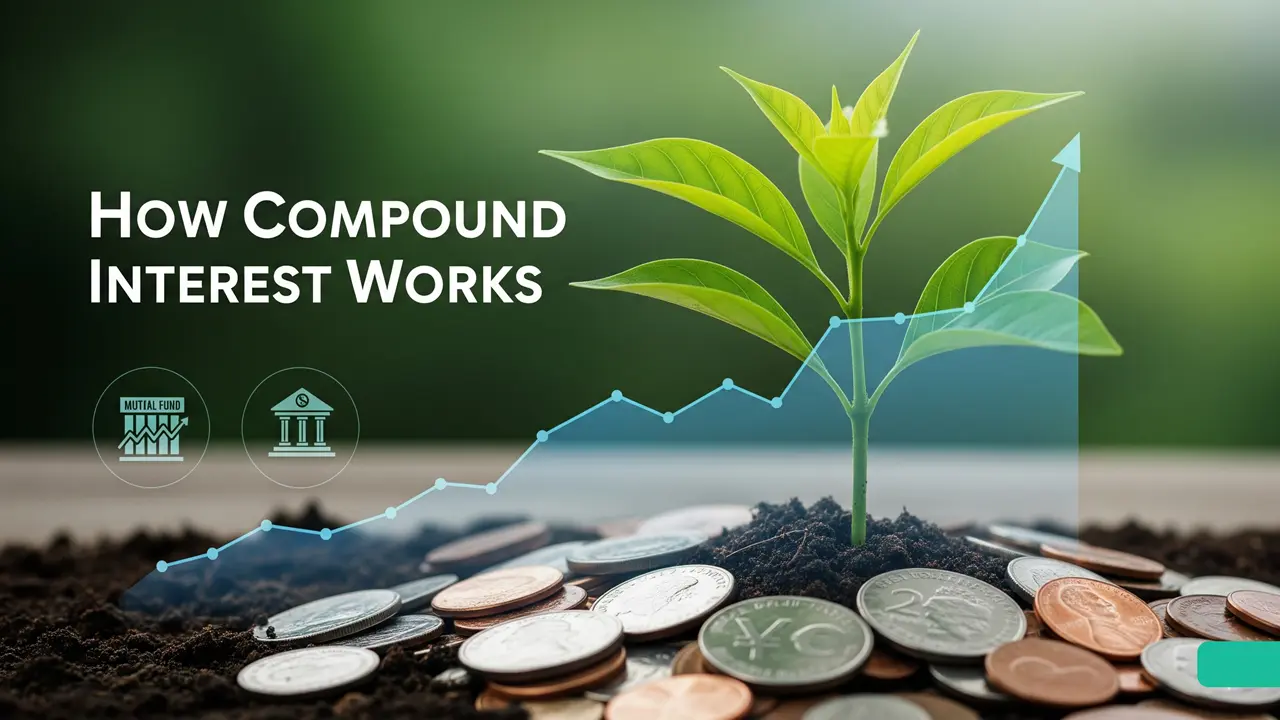
Ever heard the phrase “money makes money”? That’s compound interest at work, turning small savings into big wealth over time. In India, whether it’s a mutual fund SIP or a fixed deposit, compounding is the secret sauce of investing. This guide explains how compound interest works, why it’s powerful, and how to use it wisely. Ready to grow your money? Let’s break it down!
What is Compound Interest?
Compound interest is the process where your investment earns interest, and that interest earns more interest, creating a snowball effect. Unlike simple interest, which applies only to the initial amount, compounding multiplies your returns over time. Priya, a Mumbai teacher, invested ₹10,000 in a mutual fund, watching it grow exponentially. It’s like planting a seed that grows into a tree, bearing more fruit each season.
How Does Compound Interest Work?
When you invest, your money earns returns—say, through interest or market gains. These returns are added to your principal, and the next cycle earns returns on the new total. Ankit, a Delhi student, started a ₹1,000 monthly SIP; his returns grew faster as his investment swelled. The longer your money compounds, the bigger the growth, making time your biggest ally.
The Magic of Compounding
Compounding’s power lies in time and reinvestment. A small amount invested regularly can grow significantly. Neha, a Bengaluru freelancer, invested ₹2,000 monthly in a mutual fund. Over a decade, her total investment grew far beyond her contributions due to compounding. The earlier you start, the more your money multiplies, turning modest sums into substantial wealth.
Investments That Use Compounding
Several investments in India leverage compounding. Fixed deposits (FDs) reinvest interest quarterly or annually. Mutual fund SIPs grow through market returns. Public Provident Fund (PPF) and National Savings Certificate (NSC) offer guaranteed compounding. Rohan, a Chennai engineer, uses a PPF for tax-free growth. Choose SEBI or RBI-regulated options for safety and consistent returns.
Fixed Deposits and Compounding
FDs, offered by RBI-regulated banks, compound interest periodically. You deposit a lump sum, and interest is added to the principal, growing your investment. Shalini, a Hyderabad nurse, put ₹50,000 in an FD, watching it grow with quarterly compounding. FDs are safe, insured up to ₹5 lakh by DICGC, making them ideal for risk-averse investors seeking steady growth.
Mutual Funds and SIPs
Mutual funds, especially equity funds, use compounding through reinvested market gains. SIPs allow regular investments, amplifying compounding. Meera, a Kolkata shop owner, invests ₹1,000 monthly in an equity fund, seeing her wealth grow as returns compound. SEBI-regulated funds ensure transparency. SIPs suit beginners, letting small amounts grow significantly over long periods.
Public Provident Fund (PPF)
PPF, a government-backed scheme, offers tax-free compounding with a fixed interest rate. Contributions up to ₹1.5 lakh qualify for tax deductions. Ravi, a Pune driver, invests ₹5,000 yearly in PPF, watching it grow over 15 years. With partial withdrawals allowed after a few years, PPF is perfect for long-term goals like retirement or education.
Power of Starting Early
Starting early maximizes compounding. A ₹1,000 monthly investment at age 25 grows much more than the same at 35, due to extra years of compounding. Priya started her SIP at 25, outpacing her friend who began at 35. Even small amounts, like ₹500 monthly, can grow into lakhs over decades. Time is the key to unlocking compounding’s potential.
Reinvesting Returns
To maximize compounding, reinvest your returns instead of withdrawing them. Mutual fund dividends, if reinvested, boost growth. Ankit chose a growth option for his mutual fund, letting profits compound. FDs with cumulative interest reinvest automatically. Avoid spending returns early—Neha reinvested her FD interest, significantly increasing her final payout over years.
Impact of Compounding Frequency
Compounding frequency—daily, monthly, quarterly, or annually—affects growth. More frequent compounding (e.g., quarterly in FDs) yields higher returns. Shalini’s FD with quarterly compounding grew faster than annual compounding. Mutual funds compound based on market performance, not fixed intervals. Check your investment’s terms on financial websites to understand its compounding schedule.
Risks to Consider
Compounding isn’t risk-free. Equity mutual funds face market volatility—returns aren’t guaranteed. FDs and PPF are safer but may not outpace high inflation. Meera’s mutual fund dipped during a market slump but recovered over time. Diversify across investments to balance risk. Keep an emergency fund (3-6 months’ expenses) to avoid withdrawing early.
Tax Implications
Tax rules impact compounding. PPF returns are tax-free, while FD interest is taxed per your slab. Equity mutual fund gains held over a year face lower taxes. Ravi’s PPF saved him tax, unlike his FD. Check tax benefits, like Section 80C for PPF or ELSS, on financial websites. Plan investments to minimize tax and maximize compounding.
How to Start Compounding
Open an account with a SEBI-regulated mutual fund or RBI-regulated bank. Complete KYC with PAN and Aadhaar. Start with ₹500 for mutual fund SIPs or ₹5,000 for FDs. Ankit used an investment app for his SIP, setting up auto-debit. Research options on financial portals or consult a SEBI-registered advisor to pick the best compounding vehicle.
Tips for Maximizing Compounding
Start small with SIPs or FDs to build discipline. Reinvest returns instead of spending them. Stay invested for 5-10 years to see compounding shine. Monitor investments every 6-12 months via apps. Priya tracks her SIPs on a financial portal. Diversify across FDs, PPF, and mutual funds. Avoid unregulated schemes promising unrealistic returns.
Common Mistakes to Avoid
Don’t withdraw returns early—it breaks compounding’s momentum. Avoid chasing high returns without understanding risks—Rohan lost ₹5,000 in a risky fund. Don’t skip regular investments; consistency fuels compounding. Neha paused her SIP, slowing her growth. Use only SEBI or RBI-regulated platforms. Research thoroughly to avoid scams or high-fee investments that eat into returns.
Why Compounding Matters in India
India’s growing economy makes compounding powerful for wealth-building. Small, regular investments suit students, professionals, and homemakers. SEBI and RBI oversight ensures safety. Shalini loves how her ₹500 SIP grows steadily. With digital platforms simplifying access, anyone can harness compounding to achieve goals like buying a home or funding education.
Conclusion
Compound interest is your wealth-building superpower, turning small investments into big savings over time. Whether through FDs, mutual funds, or PPF, start early, reinvest returns, and stay disciplined. Use SEBI or RBI-regulated platforms and diversify to manage risks. Ready to let compounding work its magic? Share your investment plan in the comments!
Frequently Asked Questions (FAQ)
What is compound interest?
It’s when your investment earns returns, and those returns earn more returns, growing your money exponentially.
Which investments use compounding?
Fixed deposits, mutual fund SIPs, PPF, and NSC offer compounding through reinvested returns.
How long does compounding take to work?
5-10 years or more maximizes growth, as compounding needs time to snowball.
Is compounding risk-free?
No, equity funds face market risks; FDs and PPF are safer but may lag inflation.
How can I start compounding with small amounts?
Begin with ₹500 SIPs or ₹5,000 FDs on SEBI or RBI-regulated platforms.