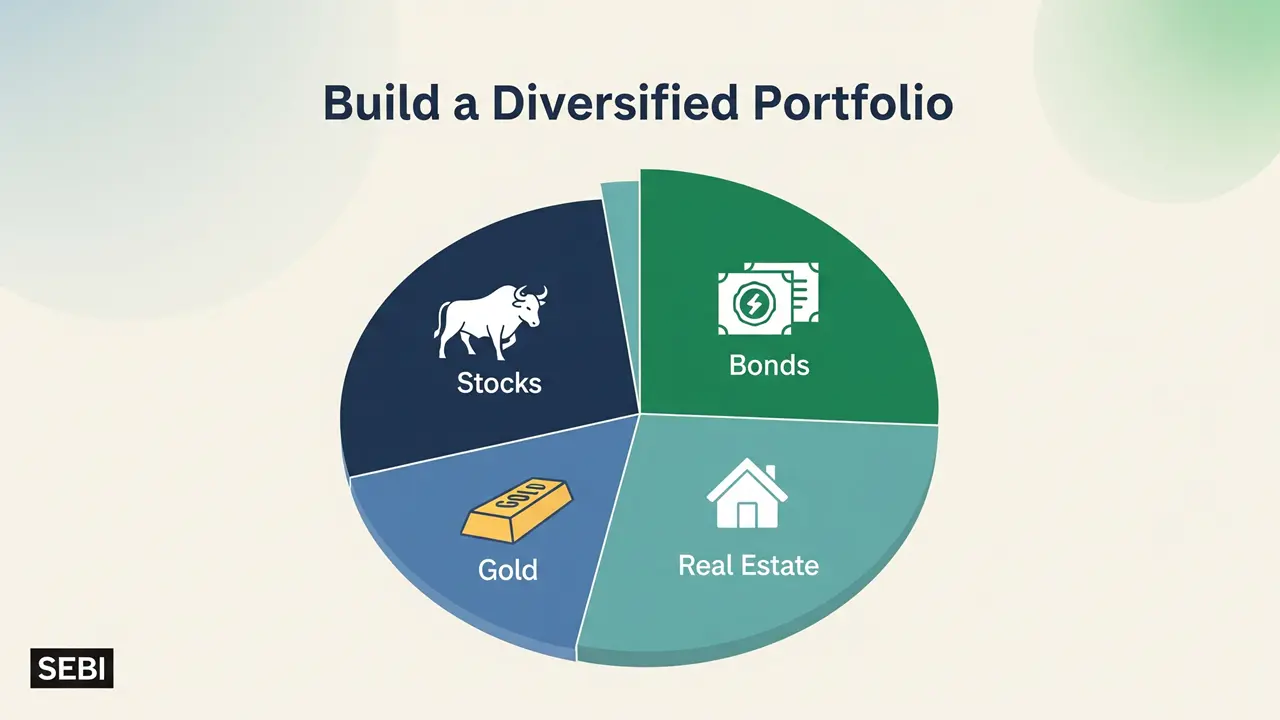
Imagine your money as a cricket team—you wouldn’t want only bowlers or batters, right? A diversified investment portfolio mixes different assets to balance risk and reward. In India, with SEBI and RBI-regulated options like stocks, mutual funds, and gold, building a diverse portfolio is easier than ever. This guide shows you how to create one that suits your goals. Ready to play smart? Let’s get started!
What is a Diversified Investment Portfolio?
A diversified portfolio spreads your money across various assets—stocks, bonds, real estate, gold—to reduce risk. If one asset dips, others may balance it out. Priya, a Mumbai teacher, invests in mutual funds, fixed deposits, and gold, cushioning market slumps. Diversification minimizes losses while aiming for steady growth, making it ideal for beginners and seasoned investors alike.
Why Diversification Matters
Diversification lowers the risk of losing everything if one investment fails. Stocks may crash, but bonds or gold can hold steady. Ankit, a Delhi engineer, lost 20% in stocks during a downturn, but his fixed deposits stayed safe. It also boosts returns by tapping different markets. In India’s growing economy, a mixed portfolio can capture opportunities across sectors.
Step 1: Define Your Financial Goals
Start by identifying your goals—retirement, a home, or education. Short-term goals (1-3 years) need safer assets; long-term goals (5+ years) can handle riskier ones. Neha, a Bengaluru freelancer, aims to buy a car in 3 years and retire in 20. Clear goals guide your asset mix, ensuring your portfolio aligns with your timeline and risk tolerance.
Step 2: Assess Your Risk Tolerance
Your risk tolerance depends on income, age, and financial stability. Young investors like Rohan, a Chennai entrepreneur, can afford riskier stocks for growth. Retirees prefer safer fixed deposits. Take online risk assessment quizzes on financial websites to gauge your comfort level. A balanced portfolio mixes high-risk (stocks) and low-risk (bonds, FDs) assets to suit your profile.
Step 3: Choose Asset Classes
Spread investments across asset classes: equities (stocks, mutual funds), debt (fixed deposits, bonds), real estate (REITs), and commodities (gold). Shalini, a Hyderabad nurse, allocates 50% to mutual funds, 30% to FDs, and 20% to gold. Each class behaves differently—equities grow fast, debt offers stability, and gold hedges inflation. Diversify to balance growth and safety.
Step 4: Invest in Equities
Equities, like stocks or mutual funds, offer high growth for long-term goals. SEBI-regulated mutual funds are beginner-friendly, with SIPs starting at ₹500. Meera, a Kolkata shop owner, invests ₹2,000 monthly in a large-cap fund. Stocks require a demat account but allow direct ownership. Choose diversified funds or blue-chip stocks to reduce sector-specific risks.
Step 5: Add Debt Instruments
Debt instruments, like fixed deposits or debt mutual funds, provide stability. RBI-regulated FDs are insured up to ₹5 lakh, offering guaranteed returns. Ravi, a Pune driver, puts ₹50,000 in an FD for safety. Debt funds, SEBI-regulated, invest in bonds for modest returns. Allocate 20-40% to debt for short-term goals or to cushion market volatility.
Step 6: Include Gold and Commodities
Gold acts as a hedge against inflation and market crashes. Options include physical gold, ETFs, or Sovereign Gold Bonds (SGBs). Priya buys ₹5,000 in digital gold monthly via a regulated app. SGBs, backed by RBI, offer interest and price growth. Allocate 10-20% to gold for stability, especially during economic uncertainty, to balance riskier equities.
Step 7: Explore Real Estate
Real estate offers tangible assets and rental income but requires large capital. Real Estate Investment Trusts (REITs) allow smaller investments, starting at ₹10,000. Ankit invested in a REIT for rental-like returns without property hassles. SEBI-regulated REITs ensure transparency. Allocate 10-20% to real estate for diversification, but ensure liquidity for other needs.
Step 8: Use Systematic Investment Plans (SIPs)
SIPs in mutual funds or ETFs promote disciplined investing. Neha’s ₹1,000 monthly SIP spreads risk through rupee cost averaging. Start with equity or hybrid funds for growth, balancing with debt funds. SEBI-regulated platforms simplify SIP setup. Regular investments reduce the need to time markets, making diversification easier for beginners with small budgets.
Step 9: Rebalance Your Portfolio
Markets change, so rebalance your portfolio every 6-12 months. If equities grow too much, sell some and invest in debt or gold. Rohan rebalanced his portfolio after stocks outgrew his FDs. Use financial apps to track allocations. Rebalancing keeps your risk level aligned with your goals, ensuring steady growth without overexposure.
Step 10: Monitor and Adjust
Track your portfolio’s performance using investment platforms or financial websites. Shalini reviews her investments quarterly, tweaking based on goals. Don’t react to short-term market dips—focus on long-term trends. Consult a SEBI-registered advisor to adjust for life changes, like a new job or marriage. Regular monitoring keeps your portfolio diversified and on track.
Benefits of Diversification
Diversification reduces losses—if stocks fall, bonds or gold may stabilize your portfolio. It captures growth across sectors, boosting returns. Meera’s mixed portfolio weathered a stock market dip thanks to her FDs. It also builds financial discipline, encouraging steady investing. India’s regulated investment options make diversification safe and accessible for all budgets.
Risks to Manage
No portfolio is risk-free—equities face market volatility, debt lags inflation, and real estate can be illiquid. Ravi lost 15% in stocks but was saved by his gold holdings. Over-diversification can dilute returns, so limit to 4-5 asset types. Keep an emergency fund (3-6 months’ expenses) to avoid selling investments early. Stick to regulated platforms.
Tax Considerations
Equity gains (over a year) face lower taxes; debt gains follow your income slab. Gold ETFs and SGBs have tax benefits for long-term holdings. Ankit’s ELSS fund saved him tax via Section 80C. Check tax rules on financial websites to optimize your portfolio. Diversify across tax-efficient options like PPF or SGBs to maximize returns.
Tips for Building a Portfolio
Start with ₹1,000-₹5,000 in SIPs or FDs. Diversify across 3-5 asset classes—equities, debt, gold, REITs. Use SEBI or RBI-regulated platforms. Monitor via financial apps. Priya tracks her portfolio monthly. Reinvest returns for compounding. Consult a SEBI-registered advisor for tailored plans. Avoid unregulated schemes promising high returns to protect your money.
Common Mistakes to Avoid
Don’t put all money in one asset—diversify to spread risk. Avoid chasing hot stocks or properties without research; Neha lost ₹10,000 in a trendy stock. Don’t ignore fees—high expense ratios eat returns. Skip frequent trading to save costs. Use only SEBI or RBI-regulated platforms to avoid scams. Stay patient for long-term gains.
Conclusion
Building a diversified investment portfolio in India is about mixing equities, debt, gold, and real estate to balance risk and reward. Start small, align with your goals, and use SEBI or RBI-regulated platforms. Rebalance regularly and stay disciplined to grow wealth. Ready to create your portfolio? Share your plan in the comments and start investing smartly!
Frequently Asked Questions (FAQ)
Why is diversification important in investing?
It reduces risk by spreading money across assets, balancing losses with gains.
What assets should I include in my portfolio?
Mix equities (stocks, mutual funds), debt (FDs, bonds), gold, and real estate (REITs).
How much should I invest to diversify?
Start with ₹1,000-₹5,000 across SIPs, FDs, or gold for small budgets.
How often should I rebalance my portfolio?
Every 6-12 months to maintain your desired risk and asset allocation.
Where can I invest safely?
Use SEBI-regulated mutual funds or RBI-regulated banks for secure investments.